Garage Floor Epoxy
Coatings that survive Denver winters: road salt, freeze-thaw and a car parked on the same
Every coating starts with the concrete under it. The slab is assessed, prepared and tested before a system is recommended.
Two to four days on a residential floor. Polishing is slower than coating per square foot, but there is no cure window to wait out.
1. Evaluate the slab. Hardness, aggregate and flatness decide the grit sequence. Denver-area concrete varies with the mix and the age.
2. Grind the metal. Coarse diamonds cut the surface flat and remove old coatings or glue.
3. Densify. Lithium densifier reacts with free lime to harden the top layer.
4. Polish and guard. Progressively finer diamonds, then a stain guard if the floor needs one.
What changes the schedule. Slab condition, square footage, moisture readings and temperature. Denver work below about 50 F needs the space heated rather than the schedule rushed.
This service is quoted across the Denver metro — Aurora, Lakewood, Arvada, Thornton, Westminster, Centennial, Highlands Ranch, Littleton, Englewood, Wheat Ridge, Golden, Broomfield, Commerce City, Northglenn, Parker, Castle Rock, Brighton, Longmont and Greenwood Village.
Coatings that survive Denver winters: road salt, freeze-thaw and a car parked on the same
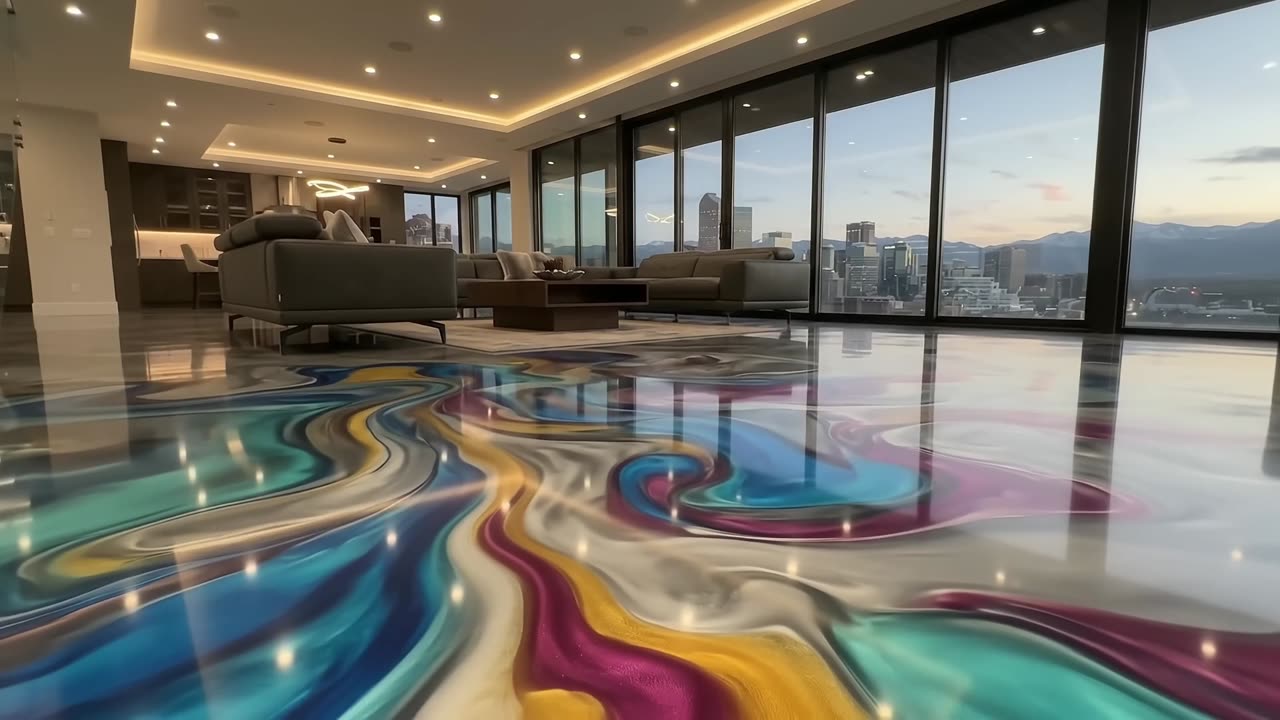
Pigmented metallic systems for living spaces, showrooms and basements, where the floor is
Full-broadcast vinyl flake with a polyaspartic topcoat — the workhorse system for garages
Mechanical polishing with densifiers — no film to peel, and no coating to fail over a movi
Poured resin surfaces for kitchen islands, bar tops and workbenches, over an existing subs
A basement floor is a moisture question before it is a finish question.
Faster cure and better UV stability than standard epoxy — the topcoat that keeps a floor f
Fixing the slab before covering it — cracks, spalls, delamination and old failing coatings
Published Denver ranges run $4 to $6 per square foot for a single-color system with a clear coat, $6 to $9 for full-broadcast flake with a polyaspartic topcoat, and $7 to $12 for metallic. A two-car garage typically lands between $1,800 and $5,500 installed.
A coating over an existing slab is a finish, not permitted work. Structural, drainage, electrical or egress work is permitted. In Denver that means Denver Community Planning & Development; in the suburbs each city runs its own building department.
Denver-series soils are fine, smectitic clays that drain slowly. Water vapour moving up through the slab collects under a coating and blisters it. The thresholds are below 5 lb per 1,000 sq ft per 24 hours (ASTM F1869) or below 75% RH (ASTM F2170).
The system changes, not just the schedule. A vapour-barrier system, or a polishing scope with no film at all, is the honest answer over a wet slab.
Standard epoxy wants a slab above roughly 50 F. Denver winter work needs the space heated rather than rushed. Polyaspartic tolerates cooler starts but still wants a warm slab.
Call, or send the details and let a local crew quote it.